


Automated alkalinity testing has evolved beyond traditional manual test kits. Today’s market offers several measurement technologies, in the following article we compare direct titration (e.g. KH Director®) , pH-differential methods (e.g. Aquawiz®), and colorimetric analysis (e.g. Hanna Checker®). Each approach has specific strengths and limitations that directly impact measurement accuracy, long-term stability, and maintenance requirements. The following comparison provides a fact-based overview of these methods.
| CRITERION | KH DIRECTOR® (TITRATION) | PH-DIFFERENTIAL METHODS | COLORIMETRIC METHODS |
|---|---|---|---|
| Measurement Principle | Direct titration with reagent | Indirect calculation via pH comparison after aeration | Colorimetric reagent analysis |
| Accuracy (spec) | ±0.1 dKH (100ml sample) | ±0.03 - 0.05 dKH (marketing claims) | ±0.1 - 0.2 dKH |
| Real-world Accuracy | ±0.1 dKH consistently | ±0.2 - 0.8 dKH drift between calibrations* | ±0.1 - 0.3 dKH |
| Long-term Stability | ✓ Stable over months/years | ✗ Systematic drift between calibrations | ✓ Generally stable |
| Test Duration | ~5-10 minutes | 40-60 minutes (per hourly test) | ~5-15 minutes |
| Environmental Sensitivity | Low | High (evaporation, temperature, CO2 concentration in environment, humidity affect reference solution) | Medium |
| Calibration Requirements | • pH probe calibration every 3 months (double-junction sensor) • Pump calibration as needed |
• Manual KH measurement of reference solution • pH sensor calibration (frequency varies by probe quality) • Pump calibration as needed |
No calibration required Ongoing reagent consumption per test |
| Measurement Automation | Automatic, user-configurable | Automatic, user-configurable (varies by device) | Typically manual |
| Automated Control & Dosing | ✓ Built-in control algorithms MULTIPLE STRATEGIES |
Varies by device | Typically not available |
| System Integration | Standalone operation OR ProfiLux ecosystem integration | Typically standalone | Typically standalone |
*) Real-world user reports document drift up to 0.8 dKH after several weeks without recalibration
Titration
The Gold Standard of Alkalinity Measurement
Titration has been the scientific standard method for alkalinity determination for over a century. The principle is both elegant and precise: a defined amount of reagent is added stepwise to a water sample until a chemical endpoint is reached. The consumed reagent volume directly corresponds to the present alkalinity – a direct, mathematically unambiguous measurement without detours through indirect calculations.
The Practical Advantages of Titration
- Long-term stability without systematic drift: Unlike indirect measurement methods, titration is not subject to systematic measurement error that builds up over weeks or months. A properly calibrated titration system delivers consistent results with ±0.1 dKH accuracy over months. This is particularly important for sensitive SPS corals, which can respond to fluctuations as small as 0.5 dKH with tissue damage.
- Low environmental sensitivity: Titration occurs in a closed measurement chamber and is largely independent of ambient temperature, humidity, or CO₂ concentration. What’s in the sample gets measured – nothing more, nothing less.
- Fast measurement cycles: At 5-10 minutes per test, the KH Director enables frequent measurement intervals. You can detect trends and deviations before they become critical, and measure multiple times daily without additional maintenance effort.
Conclusion: Professionals use titration because this method demonstrably provides the highest reproducibility and long-term stability. The KH Director implements precisely this proven technology and makes it fully automatic for aquarists.
pH-Differential Methods
Innovation with Limitations
The pH-differential method is technologically innovative: instead of titrating with reagents, alkalinity is calculated from the pH difference between tank water and a reference solution after controlled aeration. Theoretically elegant – but practically challenging.
Challenges
- The problem of systematic drift: In practice, pH-based systems can accumulate systematic measurement errors of ±0.2 to 0.75 dKH between calibrations. This drift arises from various factors: evaporation of the reference solution changes its composition, temperature differences influence pH behavior, and CO₂ from ambient air can falsify measurement results.
- High environmental dependency: The reference solution must remain stable for weeks – a practical challenge. Evaporation, temperature fluctuations, and room air quality directly influence measurement accuracy. Users report weekly to monthly recalibrations, where the reference solution must be manually measured with a classic test kit.
- Long test duration: At 40-60 minutes per measurement (including aeration phase), measurement intervals are significantly longer than titration. For hourly testing, this effectively means continuous system operation.
Conclusion: The pH-differential method can deliver usable results in stable environments with consistent maintenance – however, it requires more attention and remains more susceptible to systematic errors than direct titration.
Colorimetric Methods
Proven for Manual Testing
Colorimetric methods form the basis of most manual test kits and use color changes to determine alkalinity. This method is well-suited for occasional checks and achieves respectable accuracies of ±0.1-0.3 dKH with electronic colorimeters.
Characteristics
- Higher per-test costs: Each measurement requires individual reagent portions that are more expensive per test compared to bulk reagent solutions used in titration systems.
- Limited automation availability: Fully automated colorimetric systems with integrated dosing control are significantly rarer and less affordable on the market compared to titration-based solutions.
- Best suited for manual testing: The method excels in portable, handheld devices for spot-checking and periodic verification, but is less commonly implemented in continuous automated monitoring systems.
Conclusion: Colorimetric methods excel in manual testing applications and serve well as backup verification tools. For continuous automated monitoring and control, titration-based systems provide more cost-effective and comprehensive long-term solutions.
The KH Director
More Than Just Measurement
- Multiple control strategies: Unlike systems that merely measure and optionally offer simple two-point control, the KH Director features sophisticated control algorithms. It can execute various dosing strategies – from conservative approaches with gentle adjustments to predictive algorithms that analyze alkalinity consumption and dose proactively.
- Flexible integration: The KH Director is not an isolated system. You have a choice:
– Standalone operation: As an independent device with integrated dosing pump, the KH Director automatically controls your aquarium’s alkalinity – without additional hardware.
– ProfiLux integration: In combination with a ProfiLux controller, the KH Director becomes part of a comprehensive aquarium management system. Other dosing regimens (calcium, magnesium, trace elements) can be synchronized with alkalinity control, alarm functions activate on deviations, and all measurements are centrally logged and visualized.
This flexibility means: you’re investing in a system that can grow with your requirements. Start with standalone operation and expand later if needed – or integrate from the beginning into your existing ProfiLux setup. - Maintenance-friendly design: Calibrating the pH sensor every few months is quickly done. The double-junction sensors used achieve lifespans of 1-2 years, making them significantly more durable than simple pH probes. The pumps occasionally require calibration – a procedure that’s also necessary for all other automatic dosing systems.
Conclusion
Precision, Stability, and Control
The choice of measurement method directly impacts your corals’ health. While pH-differential systems pursue innovative approaches and colorimetric methods have their place in manual testing, titration provides the demonstrably most stable and precise foundation for automatic alkalinity control.
The KH Director uses this proven method and extends it with intelligent control functions and flexible integration options. The result: stable KH values, healthy corals, and the confidence that your system is based on the most reliable measurement technology available.
More information about the KH Director and its control strategies can be found on our KH Director product page.
KH Director Sets in the GHL Store

KHD & GHL Doser 3 SA Bundle
From: Original price was: 1.059,80 €.975,02 €Current price is: 975,02 €.From: Original price was: 1.059,80 €.975,02 €Current price is: 975,02 €.
Complete standalone bundle for automated alkalinity (KH) measurement and dosing with a price advantage compared to buying separately.
No additional controller required.
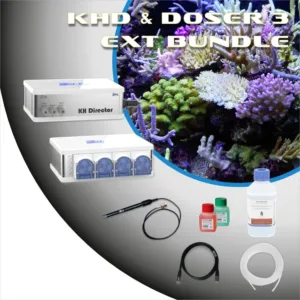
KHD & GHL Doser 3 EXT Bundle
From: Original price was: 1.009,80 €.929,02 €Current price is: 929,02 €.From: Original price was: 1.009,80 €.929,02 €Current price is: 929,02 €.
Complete bundle for automated alkalinity (KH) measurement and dosing with a price advantage compared to buying separately.
Not a standalone solution – requires a compatible GHL master device.
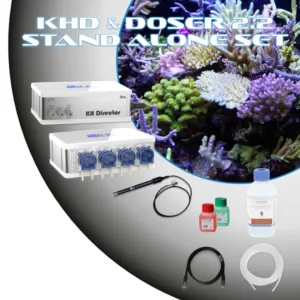
KHD & GHL Doser 2.2 SA Set
899,90 €899,90 €
Measurement device for the determination of alkalinity, with pH-electrode, calibration fluids pH4 and pH7, reagent 500 mL, silicone tube 5 m, EXT dosing pump unit, 4 pumps, stepper motors, with power supply and 2x PAB-cable 50 cm.
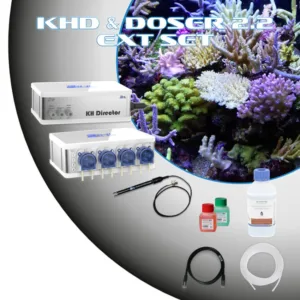
KHD & GHL Doser 2.2 EXT Set
849,90 €849,90 €
Measurement device for the determination of alkalinity, with pH-electrode, calibration fluids pH4 and pH7, reagent 500 mL, silicone tube 5 m, EXT dosing pump unit, 4 pumps, stepper motors, with power supply and 2x PAB-cable 50 cm.
Disclaimer: This comparison is based on published technical specifications, scientific principles, and documented user experiences. Product names and trademarks are the property of their respective owners. This article is intended for educational purposes and to help aquarists make informed decisions. Individual results may vary depending on specific implementation, maintenance practices, and environmental conditions.