
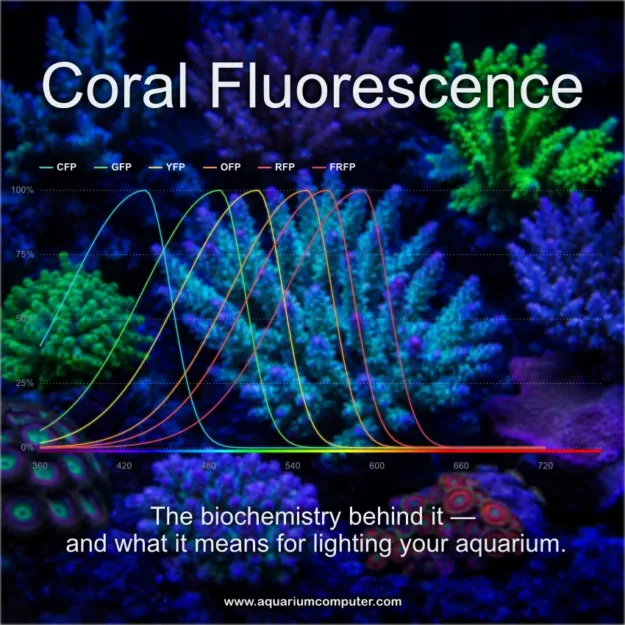
Coral Fluorescence: Biochemistry and Ideal Aquarium Lighting

Coral fluorescence results from proteins in the coral animal that absorb shorter-wavelength light and emit longer-wavelength colors, distinct from the coral’s symbiotic algae. Different fluorescent proteins require specific excitation wavelengths—blue light excites green and cyan, while orange and red proteins need green-to-yellow light. GHL’s Mitras LX8 fixture offers twelve adjustable channels spanning near-UV to Hyperred, enabling tailored lighting to both highlight fluorescence and support coral growth.
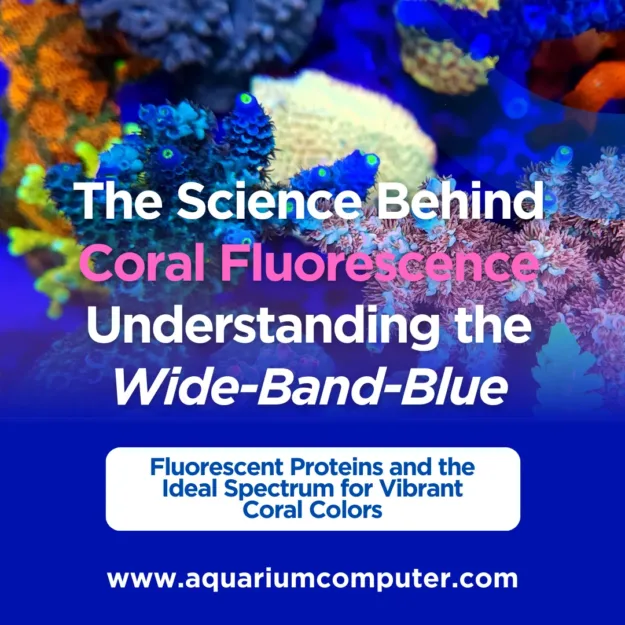

The Science Behind Coral Fluorescence: Understanding the “Wide-Band-Blue”

Corals glow because fluorescent proteins re-emit absorbed light at longer wavelengths, while chromoproteins add color by reflection. GHL’s “Wide-Band-Blue” spectrum (390–510 nm) excites the cyan and green proteins behind most of the fluorescence; additional channels reach toward violet and red for the rest of the palette — adjustable across the Mitras LX luminaires.

Understanding the Color Temperature of White Light: From Warm to Cold

When it comes to lighting, the color temperature of white light plays a pivotal role in setting the mood and functionality of a space or other areas of illumination, for instance aquarium or greenhouse lighting. The terminology used to describe these types of white — warm white, soft white, neutral white, natural white, cool white, and cold white — can often be confusing. This blog post aims to clarify these terms. The Basics of Color Temperature The Color temperature (or more precisely Correlated Color Temperature – CCT) is a way to describe the color appearance of a light source by comparing its color to the color of light emitted by a theoretical black body when heated to a particular temperature, measured in Kelvin. The idea is that if a light source has a CCT of 3,000K, its color appearance is similar to the light emitted by a black body heated…