

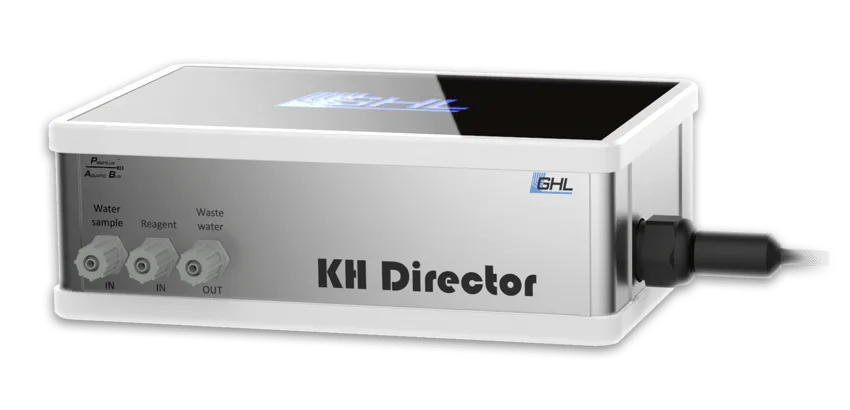
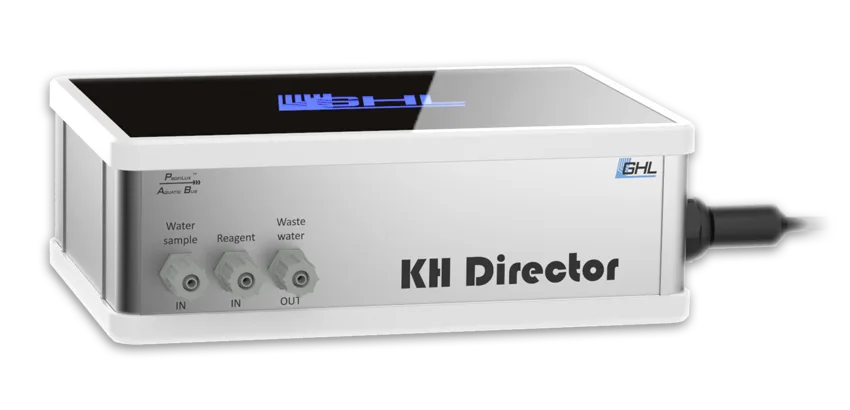
Maintaining alkalinity is paramount for stability and optimal coral growth in the intricate world of reef keeping. If you’re striving for exceptional coral conditions, alkalinity testing is non-negotiable. That’s where the KH Director® comes in – an essential component for water quality management in aquariums.
Imagine this:
You walk up to your tank. Corals are thriving. Colors popping. Growth exploding.
No more test kits. No more wondering if your KH crashed overnight. You have a magic device which measures it. Controls it. Maintains it.
Automatically. Every single day. You just sit back and enjoy what you built.
That’s not magic. That’s the KH Director®.
How The KHD Works
Precise alkalinity measurement through direct titration
The KH Director® requires a GHL Doser 2.x or 3 with at least three dosing pumps for automated alkalinity measurement and control.
The Process:
A small water sample is drawn into the KH Director®, where alkalinity is measured through precise titration—gradually adding reagent while monitoring pH. Once complete, the sample is pumped to a waste container.
The Result:
Continuous, laboratory-grade alkalinity monitoring with automated dosing adjustments based on your target values.
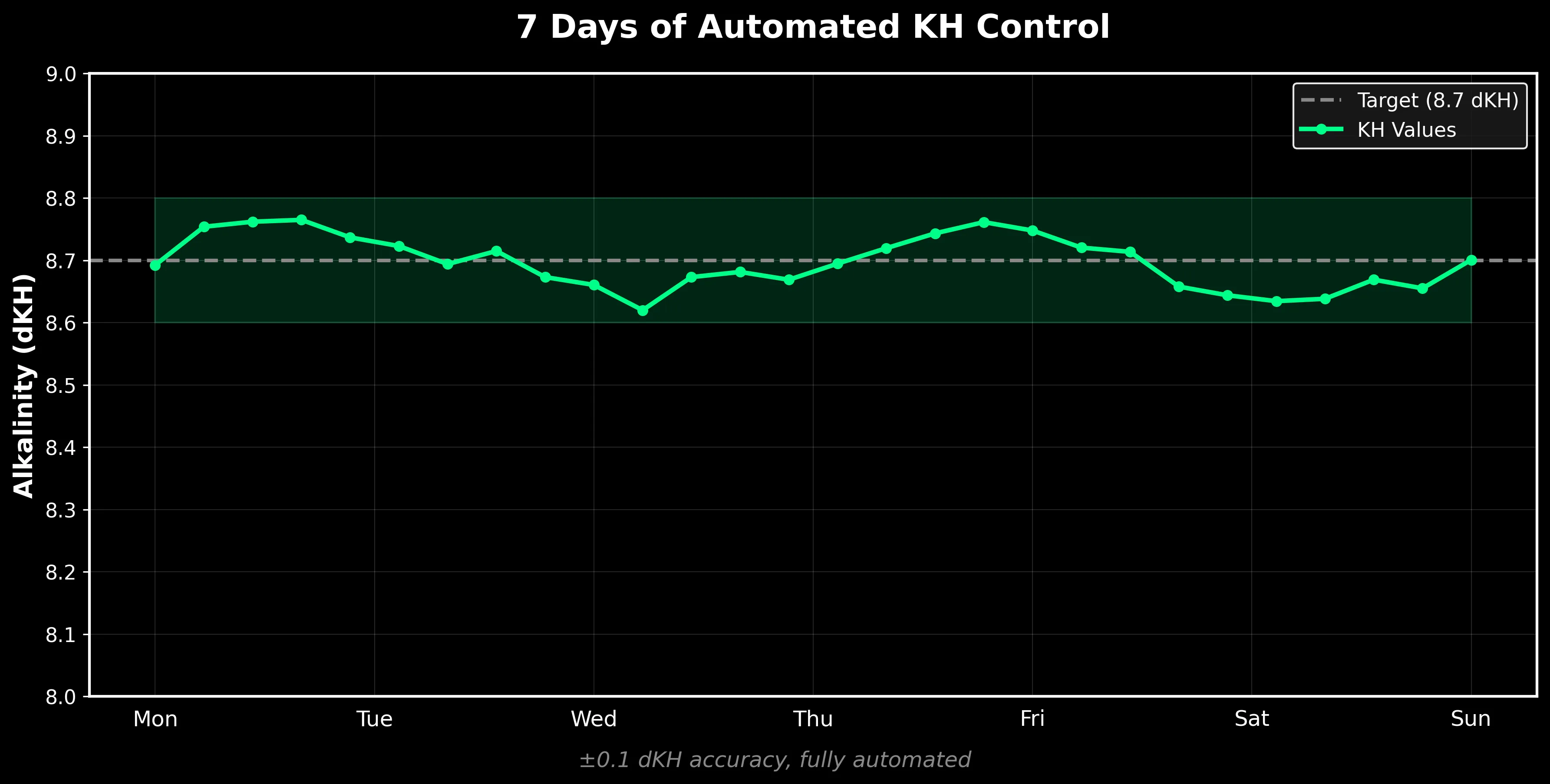
Why the KHD outperforms other systems
- Many automated alkalinity testers use cheap single-junction pH electrodes that drift significantly between calibrations. We don’t. The KH Director uses premium double-junction gel-electrolyte pH electrodes—the same technology used in professional laboratories. Result: Minimal drift, consistent ±0.1 dKH accuracy over months, not weeks.
- Others use basic pumps that drip reagent at constant speed, often overshooting the titration endpoint. We don’t. GHL Doser pumps feature variable speed control—slowing down near the endpoint to prevent overshooting.
- Combined with a magnetic shutoff valve (no dripping between tests) and an active circulation pump (complete and fast mixing of the sample and reagent), the KH Director delivers the accuracy of manual titration—automatically.
Key Features
Laboratory-grade precision meets everyday convenience

Lab-Grade Accuracy
Measures alkalinity down to 0.1° dKH using direct titration—the same method trusted by professional laboratories.

GHL Connect Integration
Monitor, control, and log data from anywhere via the GHL Connect app, web interface, or myGHL cloud.

Automated Data Logging
Access historical test results, identify trends, and optimize your dosing regimen with automatic data recording.

Flexible Testing Schedule
Adjust measurement frequency based on your tank’s needs—from multiple tests per day to once daily.

Customizable Sample Volume
Choose between 100ml samples (0.1° dKH accuracy) or smaller volumes (0.2° dKH) to minimize reagent use.

Low Operating Costs
One 1000ml reagent bottle lasts up to 3 months with 4 tests per day. pH electrode lifespan: 1-2 years.

Automated Dosing Control
Automatically adjusts KH-boosting liquid dosing based on measurement results and your target values.

Multiple Control Modes
Choose from add-on mode, adaptive mode, or calcium reactor control to match your dosing method.

Safety Features
- Plausibility check: If the last measurement result differs more than expected from the previous one the KHD starts another measurement and compares results
- Alarm: Results outside a customizable range output an alarm
- Automatic control shut off: To prevent over- or under dosing unplausible measurements deactivate automatic control
- Leakage monitoring

PAB Integration
Seamless communication with other GHL devices via the ProfiLux Aquatic Bus (PAB) system.

LED Status Display
Color-coded GHL logo provides instant visual feedback on system status and measurement activity.

Low Maintenance
Easy access to pH electrode for calibration and replacement. Maintenance-friendly design.

Laboratory-Grade Build
Robust materials and precision engineering ensure long-term reliability and consistent performance.

Connectivity
WiFi, LAN, USB (depending on master device), 2x PAB-ports

Compact Design
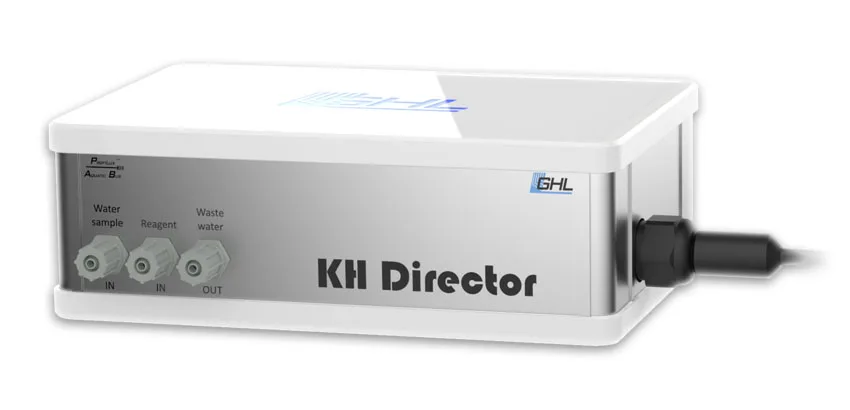
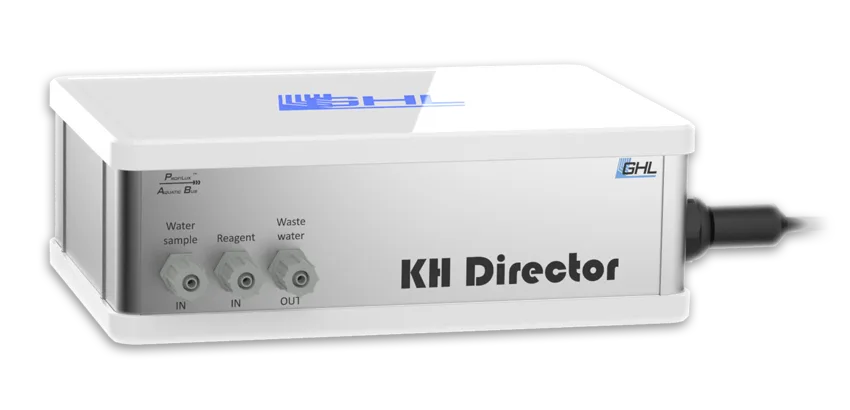
W x D x H: 220 x 150 x 75 mm / 8.66″ x 5.91″ x 2.95″. Available in black or white.
System Integration
Flexible operation modes for every setup
Standalone Operation
KH Director® + GHL Doser SA (Standalone)
The Doser Standalone acts as the master controller, managing both its own dosing pumps and the KH Director’s measurement process. The system operates autonomously without requiring additional controllers.
The Doser evaluates measurement results, calculates alkalinity values, and adjusts dosing automatically.
What you need: KH Director + Doser 2.x/3 Standalone (minimum 3 pumps)

ProfiLux Integration
KH Director® + Doser EXT + ProfiLux 4
The ProfiLux controller acts as the central master, controlling the Doser EXT and KH Director as part of a complete aquarium management system.
This enables synchronized control of alkalinity alongside all other parameters—lighting, temperature, feeding, and more.
What you need: KH Director + Doser 2.x/3 EXT (minimum 3 pumps) + ProfiLux 3 or 4

Important: The KH Director always requires a master controller—either a Doser Standalone or a ProfiLux 4. Doser EXT (Extension) models cannot operate independently and must be connected to one of these master devices.
KH Director Sets
Complete systems at competitive prices
Complete systems with significant price advantage compared to buying separately. Available in black or white.
Available Configurations:
- KH Director + GHL Doser 2.x/3 Standalone
- KH Director + GHL Doser 2.x/3 EXT
Includes PAB cable (50 cm) | Available in multiple country versions: Schuko, UK, CH, USA/CAN, AUS
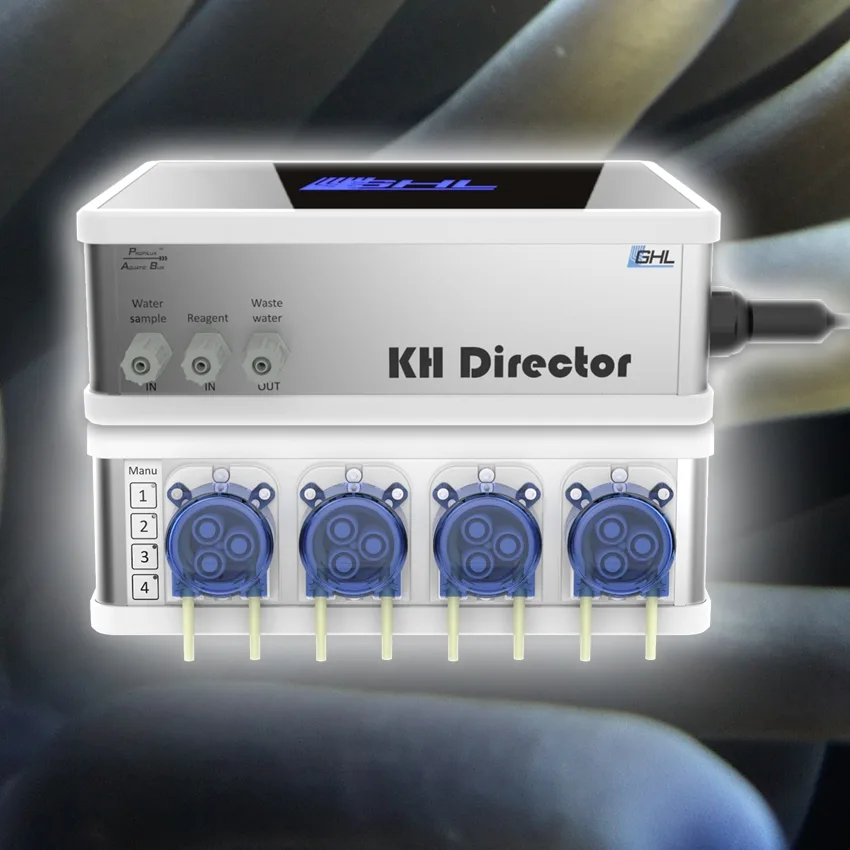
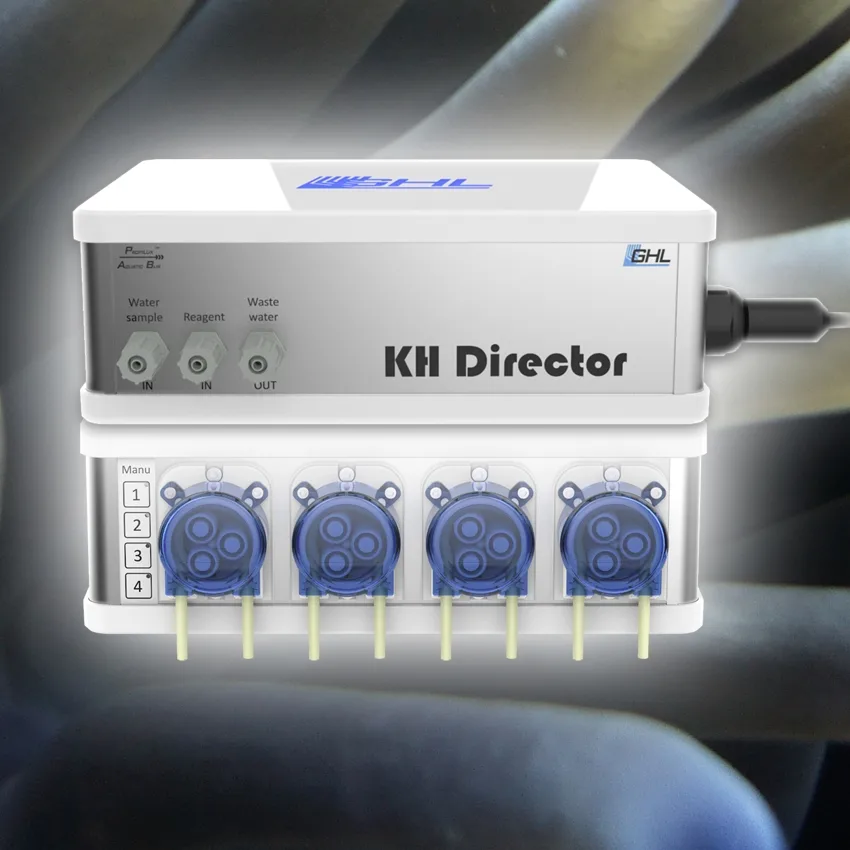
Scope of Delivery
- Device with integrated measuring cell
- pH electrode (incl. calibration liquids)
- Testing reagent 500ml
- Silicone tube 5m
- Flex-PVC tube 70cm
- Water filter
- Power-supply splitter-cable
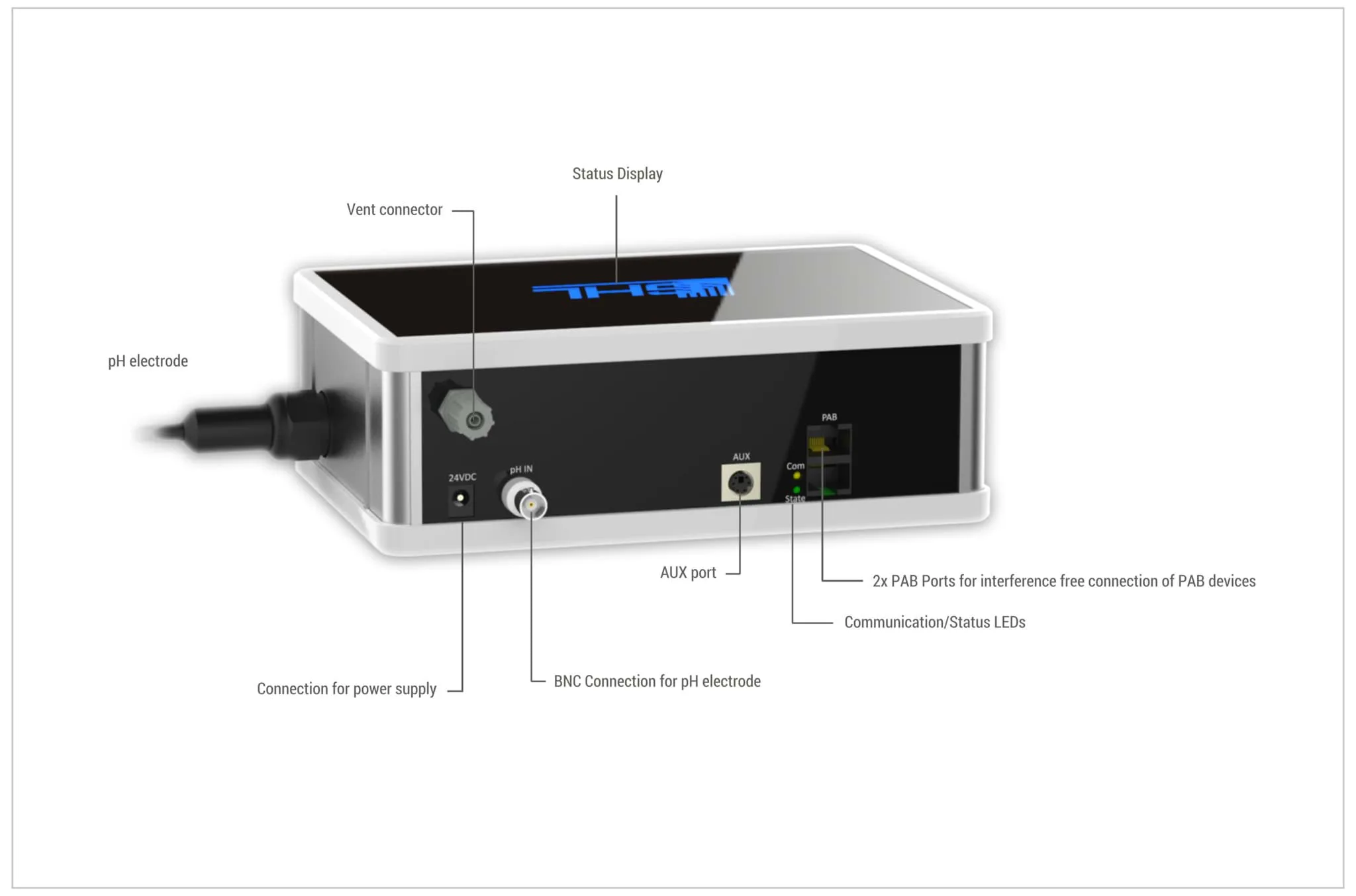
Rear view
Control Modes
Flexible dosing strategies for every method
Add-on Control Mode
Uses 1-5 dosing pumps to add liquids based on the control difference. The KHD automatically calculates quantities.
Dosages can be time-delayed to avoid dosing all liquids simultaneously, and divided into multiple sub-doses throughout the day.
Pumps can also follow a preset schedule, with KHD-calculated amounts added to the schedule.
Adaptive Control Mode
Uses 1-5 dosing pumps. You set a dosing schedule, and the KHD automatically adjusts dosing quantities based on measurements.
If KH is within target range, the schedule remains unchanged. If too low, all dosing amounts increase by a percentage. If too high, quantities are reduced.
Adjustment is calculated automatically based on the control difference.
Calcium Reactor Control
Down-regulates a calcium reactor based on KH values.
The KHD can switch off CO2 when the KH target value is reached. Otherwise, normal CO2 control remains active.
**Note:** Only available when using a ProfiLux Aquarium Controller.
Learn more
About KH Management
Alkalinity Measurement Methods Compared: Titration vs pH-Differential vs Colorimetric
A technical comparison of three automated alkalinity measurement methods: direct titration, pH-differential calculation, and colorimetric analysis. Learn the practical differences in accuracy, stability, and automation potential.
Achieving Alkalinity Stability with the KH Director
In reef keeping, the single most important factor that can make or break a tank is without a doubt Alkalinity. This parameter plays a major role in the proper growth and development of your coral. Understanding KH consumption When it comes to Alkalinity, it is important to note that the consumption rate throughout the day is anything but consistent. Corals do not consume the same amounts of ALK throughout the day. Why? This happens because corals consume Alkalinity 24 hours a day with the highest consumption rate happening during your tank’s photoperiod. After the lights turn OFF for the day, the corals continue consuming ALK, but in lesser amounts. Despite lower consumption at night, ALK is continuously being used up. It is also worth noting that although corals are the primary consumers of ALK, other factors that typically influence consumption rates include salinity stability, bacteria health, trace element content/stability, etc.…
Last updated on: February 1, 2026