

Summary #
pH and Redox (ORP) sensors are available with two different reference cell designs: single junction and double junction. This article explains the difference between the two designs, how it affects measurement reliability and sensor lifetime, and which type GHL uses.
Applies to #
- GHL pH sensors
- GHL Redox sensors
- KH Director (pH sensor)
- Compatible controller:
- ProfiLux 4 Series (incl. Industrial Line / IL)
- ProfiLux 3 Series
- ProfiLux Mini Series
Sensor Type Used by GHL #
Reliable measurement results are essential for any automated control. For this reason, GHL exclusively uses lab-grade double junction pH and Redox sensors. This also applies to the pH sensor of the KH Director.
Single vs. Double Junction #
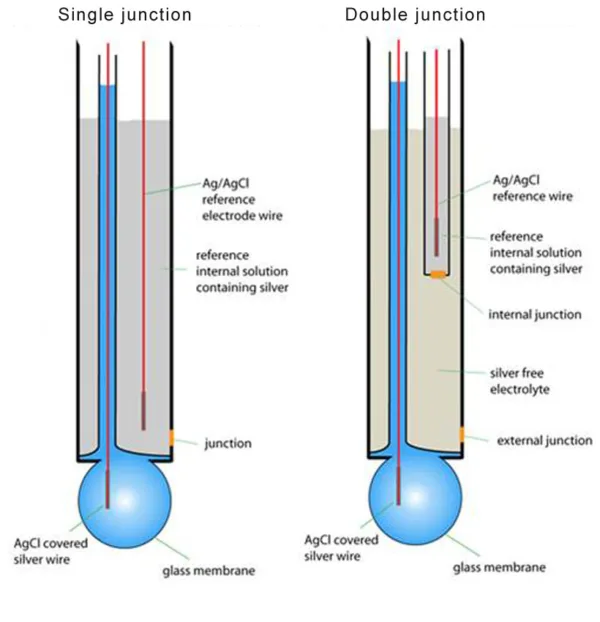
Every pH and Redox sensor contains a reference cell filled with a reference electrolyte. To function, this reference electrolyte must be in contact with the measured solution through a porous junction (diaphragm). The junction is essential for the measurement, but it is also the part most prone to disturbances.
- Single Junction: The reference cell has a single junction that is in direct contact with the measured solution. Contaminants from the aquarium water can therefore reach the reference electrolyte relatively quickly.
- Double Junction: A second chamber filled with the same reference electrolyte sits between the reference cell and the measured solution. The reference cell connects to this second chamber through its own junction, and the second chamber in turn connects to the measured solution through a second junction.
Advantages of the Double Junction Design #
- Slower Contamination: The second chamber acts as a buffer and considerably slows down contamination of the reference electrolyte. With proper care, double junction sensors can work reliably for 12 months or more.
- Protection Against Clogging: Some substances in the measured solution can react with the reference electrolyte and form solid deposits that clog the junction. The second chamber helps protect the reference cell from this effect.
- Longer Service Life: Since single junction sensors become contaminated faster, they generally have a noticeably shorter service life than double junction sensors.
Note: Even double junction sensors age over time. Regular calibration and proper care are still required for accurate readings, see Sensors – Maintenance & Calibration.