
Coral reefs cover less than 1% of the ocean floor — yet they support roughly 25% of all marine species and provide food and income to nearly one billion people worldwide. Despite their importance, they are disappearing faster than almost any other ecosystem on Earth. For anyone keeping a reef aquarium, that is not an abstract statistic.
The IMARCS Foundation — International Marine Science and Carbon Sequestration — is doing serious, field-based science to address that decline. The foundation was established by Michael Maddox, who serves as its president.
Their approach combines marine ecology, molecular genetics, and biogeochemistry, and the team behind it has the credentials to match.
Jordan Flagel, Vice President and Lead Environmental Scientist, brings over a decade of fieldwork across Belize, Guyana, and Canada, including work with the United Nations Green Corps and the International Institute for Sustainable Development.
Lead Researcher Dr. Vanessa Arranz is a Marie Skłodowska-Curie Fellow at the University of Barcelona, specializing in marine molecular ecology, population genomics, and environmental adaptation — with 17 peer-reviewed publications, all in Q1 journals.
Research Advisor Dr. Juan Moles, also at the University of Barcelona, is a marine biologist whose fieldwork spans Antarctica to the Indian Ocean, and who teaches invertebrate zoology and evolutionary biology at institutions including Harvard University.
This is not a communications organization with a science department. It is the other way around.
Four Research Programs
IMARCS currently runs four flagship projects, all centered on active reef intervention rather than passive protection.
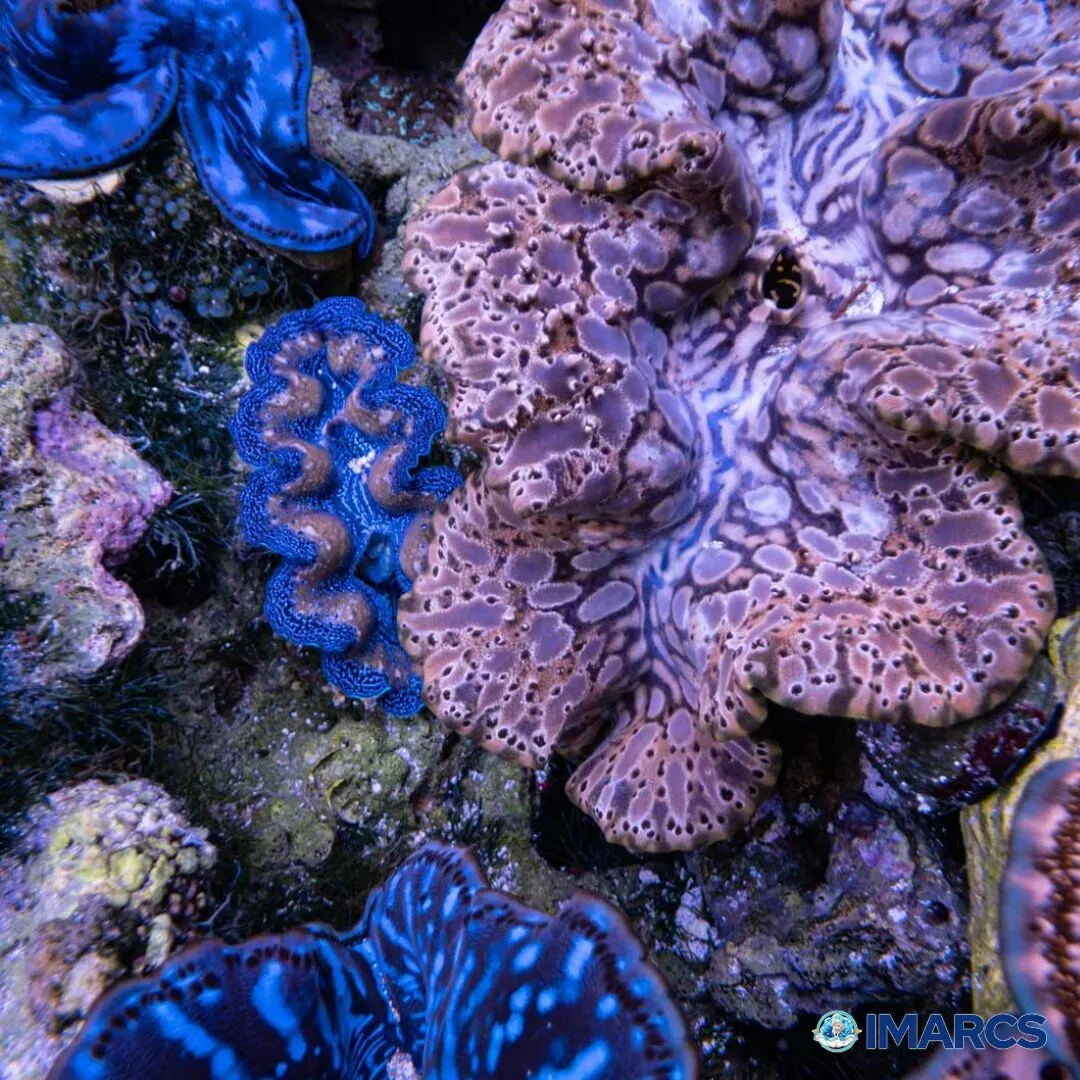
In Micronesia, they are testing whether zooxanthellae — the photosynthetic algae that corals depend on for survival — sourced from giant clams can help bleached corals recover and improve their heat tolerance. Giant clams inhabit some of the most thermally variable reef environments, and their symbionts may have evolved superior heat resistance as a result. Tissue samples collected in partnership with the Kosrae Clam Farm are being analyzed at the University of Barcelona. Previous studies have reported thermal tolerance improvements on the order of 1–1.5°C in some coral–symbiont systems — ecologically significant numbers when coral reefs globally are under severe heat stress. IMARCS’s own peer-reviewed results are expected in mid-20
In Belize, the foundation is focused primarily on the conservation of existing mangroves, with a secondary focus on restoration — a distinction that matters: scaling conservation is faster and delivers an outsized environmental impact compared to restoration alone.
In Japan, IMARCS is testing whether raising seawater pH to ≥8.5 in mariculture tanks can tip the carbon balance of giant clam shell formation, potentially turning clam farming into a measurable carbon sink. Under normal ocean conditions, shell calcification is roughly carbon-neutral; the question is whether managed conditions can change that.
Giant clam reintroduction in Nha Trang Bay, Vietnam — in collaboration with researchers from the University of Barcelona and Nha Trang University — is a planned future focus, with field research currently on hold.
Why It Matters
During the 2023–2025 global bleaching event — the largest ever recorded — over 84% of the world’s coral reefs experienced bleaching-level heat stress. IMARCS is clear-eyed about what science alone can accomplish: their work is not a substitute for reducing carbon emissions, but a complement to it — active intervention to help reef ecosystems survive the critical decades ahead.
Peer-reviewed results from the zooxanthellae transfer research are expected in 2027.
→ Learn more at imarcs.org